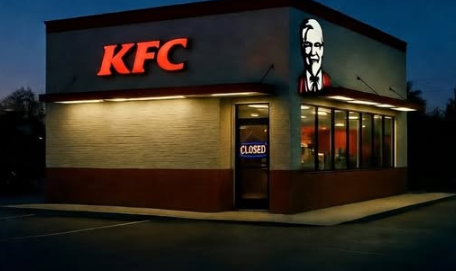
In an era saturated with advertisements, brands are continually searching for innovative ways to capture attention. KFC, one of the world’s most recognizable fast-food chains, has taken a bold step in redefining accessibility and visibility in its latest campaign. Instead of relying on traditional posters, flashy slogans, or digital signage, the brand has embraced a physical absence as a statement: it has removed the doors from several of its restaurants.
The concept is simple yet profound. In a crowded advertising environment, where consumers are bombarded by visual noise from every direction, the absence of a door speaks louder than words. The building itself communicates a message that is instantly recognizable, understandable, and culturally resonant: KFC is “always open.”
The Concept Behind “Out-Door”
Dubbed the “Out-Door” campaign, the initiative goes beyond the symbolic act of removing doors. KFC repurposes these removed elements into functional tools for communication, combining creativity with practicality.
Rather than discarding the doors, they are transformed into outdoor displays featuring playful and confident messaging. This approach turns subtraction into storytelling — a marketing strategy where removing a familiar element can convey meaning more powerfully than adding more visuals or text.
In essence, the campaign embodies the principle that sometimes, doing less communicates more. The absence of the door becomes a statement in itself, breaking expectation and prompting curiosity from customers. It doesn’t rely on cluttered signage or complicated instructions. The message is direct, yet subtle: KFC is always ready to serve.
Marketing Through Environment
Traditionally, advertising focuses on addition: adding billboards, adding colors, adding campaigns. The KFC approach flips this on its head. By removing something essential — the door — the brand uses the environment itself as a medium for marketing.
Environmental marketing, sometimes called ambient marketing, leverages real-world spaces to deliver a message organically. It moves beyond print and digital ads to engage audiences in their physical surroundings. The doorless KFC locations are an example of this strategy executed elegantly. The absence is noticeable, intuitive, and memorable — requiring no explanation.
From a psychological standpoint, this works because humans are attuned to deviations from expectations. A missing door immediately signals something unusual, prompting attention without overwhelming the audience with extra information. It creates curiosity, engagement, and a subtle sense of discovery.
Creativity Meets Practicality
While the campaign is visually striking, it also serves a practical function. QR codes are placed on the repurposed doors, guiding customers to nearby open locations. This feature is especially useful late at night or in unfamiliar areas, seamlessly blending creativity with convenience.
This combination reflects a broader trend in modern marketing: connecting offline experiences with online behavior. In today’s digital-first world, a campaign is most effective when it bridges physical and digital spaces. By providing functional utility alongside aesthetic novelty, KFC ensures that the message is not only clever but also helpful to the consumer.
Reflecting an Always-On Culture
The campaign aligns perfectly with contemporary lifestyles. In an age where streaming services never pause, e-commerce operates 24/7, and deliveries run late into the night, a doorless restaurant symbolizes perpetual availability.
In effect, the architecture mirrors modern culture. The absence of a physical barrier reinforces the idea that KFC is there whenever hunger strikes — whether at midnight, during early morning hours, or anytime in between. The message resonates because it reflects reality rather than imposing it, making the campaign feel authentic and culturally relevant.
Why This Strategy Works
Several key elements make the “Out-Door” campaign effective:
- Immediate Comprehension: Customers instantly understand the message — no explanation or translation needed.
- Curiosity Without Confusion: The unusual setup draws attention and interest without creating ambiguity.
- Blend of Humor and Clarity: The campaign feels playful yet precise, engaging audiences without overwhelming them.
- Offline-Online Integration: QR codes and repurposed materials ensure a seamless connection between physical spaces and digital tools.
- Respects Audience Intelligence: By showing rather than shouting, KFC avoids oversaturation and builds trust.
The campaign demonstrates restraint, a quality often overlooked in modern marketing. It does not rely on gimmicks or noise but uses simplicity to make a strong, memorable impact.
Lessons in Modern Brand Communication
The “Out-Door” campaign exemplifies several truths about branding in 2026:
- Impact through subtraction: Removing a familiar element can communicate as effectively — or more effectively — than adding new visuals.
- Environmental storytelling: The physical world itself can be an advertising medium.
- Functional creativity: Campaigns should serve customers, not just impress them with aesthetics.
- Cultural resonance: Marketing is strongest when it mirrors the realities of contemporary life.
- Trust-building through subtlety: Audiences respond to campaigns that engage intelligence rather than rely on sheer volume.
In a world where attention is a scarce commodity, campaigns that respect audience intelligence stand out. KFC’s doorless restaurants provide a model for brands seeking to communicate effectively, creatively, and responsibly.
Beyond the Doors: The Psychology of Absence
Humans are naturally attuned to anomalies in their environment. This principle underpins much of marketing psychology: people notice what is missing, especially when it contrasts with expectation.
By removing doors, KFC leverages this cognitive bias. Customers experience a small but meaningful disruption to routine perception. The missing door creates a visual pause, prompting individuals to consider what it signifies. Unlike conventional ads, which compete for attention in cluttered spaces, the absence cuts through the noise organically.
This strategy also taps into the concept of symbolic availability. A restaurant without a door signals openness, accessibility, and convenience in a way that words cannot replicate. In a highly competitive fast-food market, such subtle cues can have outsized impact on brand perception and customer behavior.
The Cultural Significance of Doorless Restaurants
In many cultures, doors symbolize boundaries, entry points, and privacy. Removing them communicates something bold: a lack of barriers. For KFC, this reinforces the idea of inclusivity and perpetual service.
In practical terms, the design also encourages interaction. People are drawn into the space more intuitively, aligning with the modern preference for frictionless experiences. In combination with QR codes and other digital integrations, the doorless approach creates a seamless journey from curiosity to engagement to purchase.
Supporting Brand Identity Through Architecture
Architecture is increasingly recognized as a key medium for brand communication. Brands like Apple, Starbucks, and IKEA have long used physical design to reinforce identity and values. KFC’s approach shows how a minor architectural adjustment can amplify brand messaging dramatically.
Rather than investing in additional digital campaigns or expensive billboards, KFC relies on design itself to communicate a core promise: availability. It’s a sustainable, cost-effective, and creative solution that aligns brand identity with customer experience.
Practical Takeaways for Marketers
- Consider subtraction over addition: Sometimes removing a design element creates a more powerful message than adding more clutter.
- Leverage environmental storytelling: The physical space where customers interact with your brand is as important as the advertising you produce.
- Blend creativity with utility: Campaigns that serve a functional purpose resonate more deeply than purely aesthetic projects.
- Reflect contemporary culture: Marketing should mirror societal behaviors and lifestyles to feel authentic.
- Trust the audience: Respecting intelligence and subtlety can increase engagement and brand loyalty.
Marketers across industries can draw lessons from the “Out-Door” campaign. By challenging expectations and simplifying communication, brands can stand out in crowded markets without increasing noise or cost.
Conclusion: When Less Truly Becomes More
KFC’s doorless locations demonstrate that innovation does not require complex technology or massive budgets. Sometimes, it only requires a fresh perspective on familiar elements.
By removing doors, KFC:
- Turned architecture into storytelling
- Symbolized availability without words
- Created curiosity and engagement through absence
In doing so, the brand shows that effective marketing can be quiet, confident, and clever. It reminds us that the right kind of removal — whether literal or metaphorical — can open the strongest doors of all.
The campaign is a blueprint for how brands can communicate powerfully and responsibly in a noisy, attention-deficient world. For marketers, designers, and business leaders, it is a reminder: sometimes, saying less says the most.