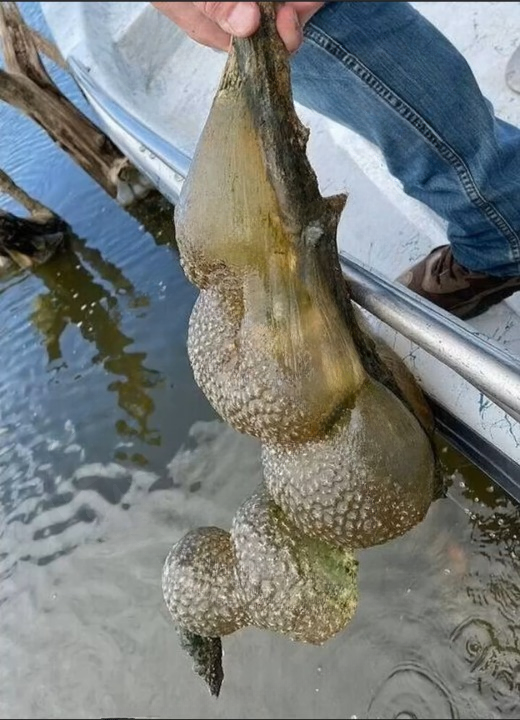
In March 2024, boaters exploring McGee Creek Reservoir in Atoka County, Oklahoma, noticed unusual translucent formations attached to submerged branches. The soft, jelly-like clusters looked different from the plants and familiar aquatic life typically seen in freshwater environments.
Some formations appeared as rounded masses beneath the water, while others seemed to hang from underwater branches. Their unusual appearance raised questions about what they were and whether they posed any danger to people, fish, or the surrounding ecosystem.
One possible explanation for formations like these is freshwater bryozoans, a group of small aquatic animals that live together in colonies. Although individual animals are tiny, their combined structures can become large enough to attract attention from anglers, boaters, and shoreline visitors.
These organisms are an interesting example of the biodiversity found beneath the surface of freshwater lakes. What may initially look like an unfamiliar substance can actually be a living community with an important place in the aquatic environment.
What Are Freshwater Bryozoans?
Bryozoans are small aquatic invertebrates sometimes known as moss animals. They live in both freshwater and marine environments, with many species attaching themselves to solid surfaces rather than swimming freely.
A colony consists of numerous individual animals called zooids. Each zooid is small, but together they form a connected structure that can develop into different shapes depending on the species.
Some colonies appear as thin coatings on rocks or plants. Others form branching structures or soft, rounded masses. Certain freshwater species produce gelatinous colonies that can become surprisingly large compared with the individual animals that make them up.
This explains why a colony may look like one large organism even though it contains many tiny animals living together.
The gelatinous material surrounding the zooids helps hold the colony together and gives it its distinctive translucent appearance. When viewed underwater, the structure may resemble a large piece of clear jelly attached to a branch.
Why Do They Look Like Transparent Jelly?
The unusual appearance of freshwater bryozoans comes partly from the material surrounding their individual zooids.
In certain species, this material is soft, gelatinous, and contains a high proportion of water. As a result, the colony can appear almost transparent when sunlight passes through it.
Its shape may be rounded, irregular, or divided into several lobes. The appearance can also change depending on the viewing angle, water clarity, and the surface supporting the colony.
Water movement may cause a gelatinous formation to shift slightly with the current. This can make it appear to be floating freely, even when it remains attached to submerged wood or vegetation.
Color can vary as well. Some colonies look nearly clear, while others may appear cloudy, pale brown, or greenish because of surrounding material and environmental conditions.
These differences can make identification difficult for someone encountering a colony for the first time. However, an unusual appearance does not automatically mean the organism is dangerous or harmful.
How Do These Tiny Animals Feed?
Despite their unusual appearance, freshwater bryozoans are filter feeders.
Rather than chasing prey, they collect tiny food particles suspended in the surrounding water. These may include microscopic algae, bacteria, and other organic material.
Individual zooids have specialized feeding structures called lophophores. These structures contain small tentacle-like extensions covered with hairlike cilia.
The movement of the cilia creates water currents that bring food particles toward the feeding structures. The particles are then collected and transported toward the animal’s mouth.
Because a colony contains many individual zooids, their combined feeding activity allows it to gather nourishment from the surrounding water.
This process connects bryozoans to the broader freshwater food web. Microscopic organisms and suspended particles provide food for small aquatic animals, which form part of a larger ecosystem involving insects, fish, and other wildlife.
Although these colonies may appear unusual, they are active biological communities rather than lifeless material caught underwater.
An Ancient Group of Animals
Bryozoans have an extensive evolutionary history, with fossils showing that the group existed hundreds of millions of years ago.
Scientists study bryozoan fossils to learn about ancient aquatic environments, biodiversity, and changes in marine ecosystems throughout geological history.
Their long fossil record makes them an interesting group for understanding the development of animal life.
However, finding a modern bryozoan colony in an Oklahoma lake does not mean it is a prehistoric creature that has survived unchanged for millions of years.
The group itself is ancient, but today’s colonies consist of living organisms that grow, reproduce, and eventually die.
Some freshwater bryozoans also produce specialized structures called statoblasts. These help certain species survive unfavorable conditions and contribute to their ability to establish new colonies.
Statoblasts are part of the organism’s life cycle, not miniature adult colonies that remain unchanged over geological time.
When conditions become suitable, they can develop into new colonies, helping the organisms persist through seasonal changes.
How Do Bryozoans Reproduce?
Freshwater bryozoans have reproductive strategies that help them establish colonies and survive changing environmental conditions.
Depending on the species, reproduction may involve both sexual and asexual processes. New zooids can develop within an existing colony, allowing its structure to expand over time.
In some freshwater species, statoblasts play an important role in reproduction and survival.
These specialized structures contain developing material that can produce a new colony when conditions become favorable. Some can remain dormant during periods when the environment is unsuitable.
This ability can be useful in lakes where temperatures, water levels, and food availability change throughout the year.
Statoblasts may also contribute to dispersal through natural processes involving water movement or animals.
As a result, colonies can appear in locations where visitors may not have noticed them previously, even if the organisms are part of the wider freshwater environment.
Why Do They Grow on Underwater Branches?
Submerged branches provide stable surfaces where many aquatic organisms can settle.
Freshwater bryozoans generally need a suitable place to attach and develop. Depending on the species, colonies may grow on wood, rocks, aquatic plants, and other solid surfaces.
A fallen branch can become a small habitat beneath the water. Algae may grow on it, microorganisms may collect around it, and small invertebrates may use it for shelter.
Bryozoans can become part of this underwater community when environmental conditions support their growth.
The wood does not need to be alive. Once submerged, fallen branches can provide suitable surfaces for a variety of organisms.
Factors such as temperature, light, water movement, and nutrient availability may influence where colonies develop.
For someone looking down from a boat, a gelatinous colony attached to a branch may appear to be suspended in the water. Its attachment point can be difficult to see, particularly when the water is cloudy.
Colonies may also be more common in some parts of a reservoir than others because suitable surfaces and environmental conditions are not always evenly distributed.
Are Freshwater Bryozoans Dangerous to People?
Freshwater bryozoans are generally considered harmless to people during ordinary recreational activities.
They are not human parasites, and their normal feeding behavior does not involve biting or attacking people. Their jelly-like appearance is not, by itself, a reason to assume they contain something dangerous.
However, it is important to identify unfamiliar material correctly before making conclusions about a particular specimen.
Several different organisms and natural materials can appear gelatinous in freshwater. Depending on the conditions, a similar-looking formation could be a bryozoan colony, an egg mass, algae, fungal growth, or another biological substance.
For that reason, visitors should avoid unnecessary handling or collection of unfamiliar formations.
If a mass is accompanied by unusual water discoloration, a strong odor, or a large number of dead fish, contacting the relevant lake authority or environmental agency may be appropriate.
These signs would not establish that the jelly-like formation caused the problem, but they could justify a closer examination of the surrounding water conditions.
Are They Harmful to Fish and Other Wildlife?
Freshwater bryozoans are part of aquatic ecosystems and are not generally considered direct threats to fish.
Their filter-feeding activity allows them to consume small particles from the water, while their colonies may provide surfaces that other tiny organisms can use.
The ecological role of a colony depends on its species, abundance, and surrounding environment. Its unusual appearance or size alone does not establish that it is invasive or damaging.
It is also important to distinguish between the presence of a natural organism and other environmental changes that may occur in the same location.
For example, changes in water quality or aquatic vegetation can have several possible causes. Observing a bryozoan colony alongside an environmental change does not prove that the colony caused it.
Determining whether an organism is native, introduced, or disruptive requires reliable identification and information about its distribution and ecological effects.
Why Might People Suddenly Notice Them?
A person can visit the same lake for years without noticing an organism that has been present in the environment for a long time.
Visibility depends on several factors, including seasonal growth, water clarity, the location of submerged objects, and the angle from which someone views the water.
Some freshwater bryozoan colonies become more noticeable during periods when environmental conditions favor their growth. As a colony develops, its structure may become large enough to attract attention.
Changes in water levels can also make previously hidden formations easier to see. A submerged branch that was once too deep may become visible when conditions change.
The observer’s location matters, too. A boater looking down through relatively clear water may notice formations that someone standing on shore would never see.
Online photographs can further increase awareness. Once an unusual formation is shared, people who have encountered similar objects may begin discussing what they saw.
This does not necessarily mean the organism has recently appeared or increased dramatically in number. It may simply have become more noticeable.
What Should You Do If You Find a Similar Formation?
If you discover a jelly-like mass attached to a submerged branch or another surface, avoid assuming that it is dangerous or immediately removing it.
A few practical steps can help:
- Observe from a safe distance: Look at its shape, color, and location without touching it.
- Take photographs: Clear images from different angles may help an aquatic specialist identify the formation.
- Note the surroundings: Record whether it is attached to wood, rocks, or vegetation.
- Avoid unnecessary disturbance: Do not remove unfamiliar organisms simply because they look unusual.
- Report concerning conditions: If you also notice dead fish, unusual odors, or major changes in water appearance, contact the appropriate environmental authority.
For ordinary sightings of suspected bryozoan colonies, there is generally no reason for alarm. Accurate identification is the best way to understand what you have found.
A Fascinating Part of Freshwater Biodiversity
The jelly-like formations reported at McGee Creek Reservoir provide an interesting opportunity to learn about freshwater organisms that many people rarely notice.
Bryozoans may be small individually, but their colonies can develop into visible structures that attract attention beneath the water.
Their filter-feeding behavior, unusual colony formation, and specialized reproductive structures make them an important subject in freshwater biology.
What initially looks like an unfamiliar underwater substance may actually be a living community made up of countless tiny animals.
The next time you notice an unusual formation beneath a lake’s surface, remember that freshwater environments contain far more life than is immediately visible. A closer look, supported by accurate identification, can reveal an interesting part of the natural world without creating unnecessary concern.